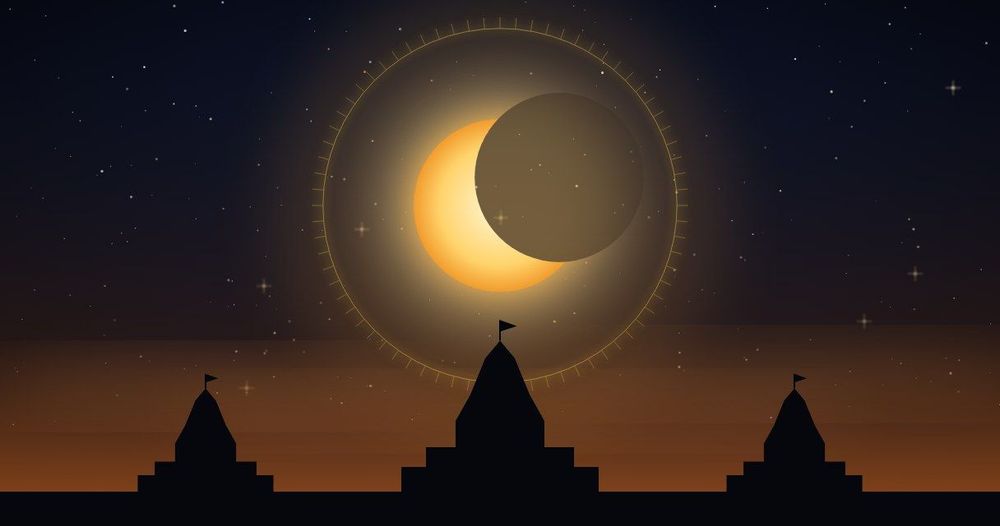
There are five eclipses in 2027, and only one of them matters for sutak in India: the total solar eclipse (Surya Grahan) of Monday, 2 August 2027. India sees it as a partial eclipse in the late afternoon, roughly 15:45 to 17:45 IST depending on your city. Bengaluru, Chennai and Mumbai see the most, about a third of the Sun covered. Delhi sees about 8%, and the north-east barely any. The annular solar eclipse of 6 February is not visible from India. The three lunar eclipses (21 February, 18 July, 17 August) are penumbral, and panchangs do not treat a penumbral eclipse as a grahan. So the only sutak of 2027 is on 2 August.
The eclipse falls in Cancer (Kark), the sign Ketu has occupied since 5 December 2026. Cancer Moon signs feel it most, followed by Aries, Libra and Capricorn.
All five eclipses of 2027 at a glance
| Date | Eclipse | Sign | Visible in India? | Sutak in India? |
|---|---|---|---|---|
| 6 Feb 2027 (Saturday) | Annular solar eclipse | Capricorn (Makar) | No | No |
| 21 Feb 2027 (Sunday) | Penumbral lunar eclipse | Leo (Singh) | Penumbral only | No, not treated as a grahan |
| 18 Jul 2027 (Sunday) | Penumbral lunar eclipse, extremely faint | Capricorn (Makar) | No | No |
| 2 Aug 2027 (Monday) | Total solar eclipse | Cancer (Kark) | Yes, as a partial eclipse | Yes |
| 17 Aug 2027 (Tuesday) | Penumbral lunar eclipse | Capricorn (Makar) | Penumbral only | No |
All positions are sidereal (Lahiri), the zodiac the AstroSamay app and panchangs use. Dates can differ by a day between panchangs, and timings by a minute or two.
Why only 2 August counts for sutak
Sutak is observed for an eclipse that can actually be seen from where you live. That rule clears three of the five straight away.
The annular eclipse of 6 February is a "ring of fire" eclipse, but its path lies far from India. Nothing of it is visible here, so there is no sutak, no temple closure and no need to change your routine.
The three lunar eclipses are penumbral. In a penumbral eclipse the Moon only passes through the Earth's faint outer shadow. It does not lose a bite; at most it looks a little dull, and the 18 July one is so faint that almost nobody would notice it. Traditional panchangs count a Chandra Grahan only when the Moon enters the Earth's dark inner shadow (the umbra), so none of these three carries sutak. If you see "Chandra Grahan 2027" lists online that show a sutak for February or August, they are counting penumbral events that the panchang tradition does not.
That leaves 2 August 2027: a genuine total solar eclipse, visible across India as a partial one.
Surya Grahan 2 August 2027: timings for your city
All times are IST. "Covered" is the share of the Sun's disc hidden at maximum. Sutak begins 12 hours before the eclipse begins in your city, which puts it in the early morning of 2 August.
| City | Sutak begins | Eclipse begins | Maximum | Eclipse ends | Covered |
|---|---|---|---|---|---|
| Delhi | 03:53 | 15:53 | 16:29 | 17:02 | about 8% |
| Jaipur | 03:50 | 15:50 | 16:31 | 17:09 | about 12% |
| Ahmedabad | 03:44 | 15:44 | 16:35 | 17:21 | about 24% |
| Mumbai | 03:47 | 15:47 | 16:41 | 17:31 | about 32% |
| Hyderabad | 03:58 | 15:58 | 16:47 | 17:33 | about 27% |
| Bengaluru | 03:58 | 15:58 | 16:53 | 17:43 | about 39% |
| Chennai | 04:02 | 16:02 | 16:54 | 17:41 | about 34% |
| Kolkata | 04:14 | 16:14 | 16:44 | 17:12 | about 6% |
| Patna | 04:10 | 16:10 | 16:38 | 17:05 | about 5% |
| Guwahati | 04:26 | 16:26 | 16:39 | 16:52 | about 1% |
Local panchangs may differ from these by a minute or two. For a town not listed, take the nearest city; the panchang for your place will carry the local figure closer to the day.
How sutak works on 2 August
For a Surya Grahan, sutak traditionally starts 12 hours before the eclipse begins (for a Chandra Grahan it is 9 hours). On 2 August that means sutak starts between about 03:45 and 04:30 in the morning, depending on your city, and ends when the eclipse ends locally, between about 16:50 and 17:45. In Delhi, for example, sutak runs from 03:53 to 17:02.
In the north-east, where only a sliver of the Sun is covered, many families still keep sutak, because the tradition follows visibility, not size. Follow your family's custom and your local panchang.
What totality is, and where it falls
A total eclipse happens when the Moon covers the Sun completely. Inside a narrow track on the Earth, day turns briefly to dusk and the Sun's outer atmosphere, the corona, becomes visible. On 2 August 2027 totality lasts about six minutes at its longest, among the longest of this century. The track crosses southern Spain, North Africa, Egypt (Luxor), Saudi Arabia and Yemen. The global maximum is at 15:36 IST. India lies outside that track, so here the Moon takes only a bite from the Sun's edge, larger in the south and west, smaller in the north and east.
Never look at the Sun without certified solar filters
This is the one line in this article that is not tradition. Do not look at the eclipse, even for a moment, without certified solar eclipse glasses or a certified solar filter (made to the ISO 12312-2 standard). A partial eclipse is still bright enough to harm the eyes, even when only 5% or 8% of the Sun is covered.
- Sunglasses, even very dark ones, are not safe.
- X-ray film, smoked glass, CDs and coloured plastic are not safe.
- Never point a phone, camera, binocular or telescope at the Sun without a proper solar filter on the front.
- A simple, safe way to watch: make a pinhole in a piece of card and let the Sun's image fall on a sheet of paper or the ground. Leaves of a tree do the same; look at the crescent shadows on the ground, not up at the Sun.
Traditions during sutak and grahan
What follows is tradition, the way many Hindu families observe a grahan. These are customs, not rules, and families differ. Take what feels right to you.
- Prayer and chanting. Grahan time is traditionally seen as good for japa. Common choices are the Gayatri Mantra, Om Namah Shivaya, and the Surya mantra Om Ghrini Suryaya Namah. Many people simply sit quietly with their own family deity's name.
- Food customs. Cooked food is traditionally not eaten during sutak. Tulsi leaves or kusha grass are placed in stored water, milk and pickles. Children, the elderly and anyone unwell or needing to eat are usually exempted, and many families relax sutak for them.
- Temples. Most temples close their sanctum during sutak and reopen after the eclipse with a cleaning.
- Bathing after. When the eclipse ends locally, people bathe, sprinkle Ganga jal at home, change clothes and cook a fresh meal.
- Daan. Giving after the eclipse is one of the most loved customs: grain, til (sesame), clothes or food for people who need them. It costs little and is said to carry special merit on a grahan day.
- Pregnant women. In many families pregnant women stay indoors during the eclipse, avoid sharp tools like knives and scissors, and rest. These are customs of care that families keep with love; they are not medical advice, and any health question belongs with your doctor.
What a solar eclipse in Cancer means astrologically
On 2 August the Sun and Moon meet in Cancer, right on Ketu's sign, with Rahu opposite in Capricorn. Cancer is the sign of the home, the mother, emotional security and the feeling of belonging. Ketu is the planet of letting go. Together they make this eclipse less about outer events and more about an emotional reset: noticing what you have outgrown at home, which old feelings you keep carrying, and where you need quiet rather than more effort.
That is why the traditional advice for this eclipse is calm. It is a good day for rest, prayer, time with your mother or elders, and clearing physical and emotional clutter. Traditionally it is not a day to start new ventures or force big decisions; let the week after it settle first.
Which rashis feel the 2 August eclipse more
By Moon sign, the eclipse falls in a different house for each rashi. Not sure of yours? Find your Moon sign first.
| Moon sign | House of the eclipse | Theme it touches | How it tends to feel |
|---|---|---|---|
| Cancer (Kark) | 1st | Self, body, mood | Most personal; a time to rest and reset |
| Aries (Mesh) | 4th | Home, mother, inner peace | Strongly felt at home; family matters ask for care |
| Libra (Tula) | 10th | Career, public role | Work priorities shift; review rather than react |
| Capricorn (Makar) | 7th | Partner, marriage, partnerships | Relationships ask for patience and honest talk |
| Sagittarius (Dhanu) | 8th | Shared money, private worries | Inward; avoid big financial decisions that week |
| Leo (Singh) | 12th | Sleep, expenses, rest | Quiet; a good time for retreat and prayer |
| Scorpio (Vrishchik) | 9th | Father, teachers, faith | Questions of belief and guidance come up |
| Pisces (Meen) | 5th | Children, studies, romance | Attention turns to children and creative plans |
| Gemini (Mithun) | 2nd | Family, speech, savings | Choose words with care in family talks |
| Taurus (Vrishabh) | 3rd | Courage, siblings, effort | Traditionally easy; energy for small brave steps |
| Virgo (Kanya) | 11th | Gains, friends, wishes | Traditionally favourable; a wish may clarify |
| Aquarius (Kumbh) | 6th | Routine, competition, health habits | Traditionally favourable; good for clearing backlogs |
The four angular placements (1st, 4th, 7th and 10th: Cancer, Aries, Capricorn and Libra) are where an eclipse shows most clearly in daily life. The 3rd, 6th and 11th (Taurus, Aquarius and Virgo) are classically the easiest.
An honest limit: transits read from the Moon sign are the same for everyone with that Moon sign, which is roughly one person in twelve. How this eclipse lands for you depends on your own birth chart and your current dasha. If the eclipse degree in Cancer falls near your Lagna, your natal Sun or Moon, it matters far more than this table can say. If nothing in your chart sits there, it may pass as an ordinary day. A personal 2027 report checks this for you.
Your own eclipse dates in the 2027 report
This is exactly what a Moon-sign article cannot do and a personal report can. In the AstroSamay Kundli and Numerology Report 2027, chapter 8, "The Dates That Matter in 2027", lists the eclipses that actually touch your own chart, alongside your dasha changes, Saturn and Jupiter sign changes and retrogrades. Every date in it is calculated from the ephemeris for your birth date, time and place; nothing is invented.
The report is prepared by Pandit Ji for your birth chart: 80+ pages made to read on a phone, 15 chapters, all 16 divisional charts, in your choice of nine languages. It costs ₹199, one time, and is delivered inside the app under My Reports within 24 hours. You can see what each chapter contains before you buy.
For the bigger picture of the year, read the 2027 yearly rashifal for all 12 signs, the Saturn transit of 2027 (Saturn is in Aries on eclipse day) and the Jupiter transit of 2027.
FAQ
When is Surya Grahan 2027 in India?
The solar eclipse visible in India is on Monday, 2 August 2027, in the late afternoon. In Delhi it runs from 15:53 to 17:02 IST, in Mumbai from 15:47 to 17:31, and in Bengaluru from 15:58 to 17:43.
Is the 6 February 2027 eclipse visible in India?
No. The annular solar eclipse of 6 February 2027 is not visible from India, so there is no sutak and no change to temple or home routines.
Is there any Chandra Grahan in 2027 with sutak?
No. The three lunar eclipses of 2027, on 21 February, 18 July and 17 August, are penumbral. Panchangs do not treat a penumbral eclipse as a grahan, so none of them carries sutak.
What time does sutak start on 2 August 2027?
Sutak starts 12 hours before the eclipse begins in your city, between about 03:45 and 04:30 in the morning (03:53 in Delhi, 03:47 in Mumbai, 04:02 in Chennai), and ends when the eclipse ends locally.
Will India see the total eclipse on 2 August 2027?
No. Totality, about six minutes long, is seen in southern Spain, North Africa, Egypt, Saudi Arabia and Yemen. India sees a partial eclipse, from about 39% covered in Bengaluru to about 1% in Guwahati.
Is it safe to watch the 2 August eclipse?
Only with certified solar eclipse glasses or a certified solar filter. Sunglasses, X-ray film and smoked glass are not safe. A pinhole projection on paper is a simple safe way to watch.
Five eclipses, one sutak, and for most people one calm, reflective afternoon. If you want to know whether 2 August touches your own chart, and which other dates in 2027 do, the Kundli and Numerology Report 2027 reads them for your exact birth details. Get it in the AstroSamay app on Google Play.